Reading/playing/listening - July 2026
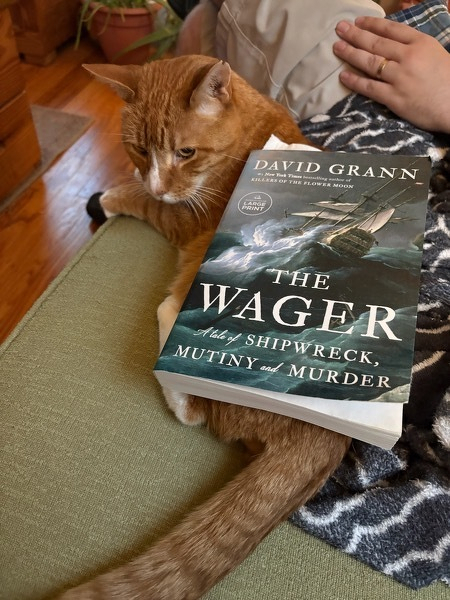
READING: I just finished The Wager by David Grann, a nonfiction account of the 18th century wreck (and ensuing mutiny) of the HMS Wager. It took me a few tries to get into it: I’m not normally a nonfiction reader or someone who particularly cares about boats or stories where a bunch of dudes are fighting with each other, but Grann’s narrative is so gripping that I finished this up in two nights. The Wager really does read like a thriller. Everything that can go wrong does go wrong for this ship - scurvy, starvation, navigational hurdles, hurricane-level storms - and they end up shipwrecked on a barren, frigid island near Patagonia. Nothing to eat, no wildlife to catch, nothing. Everyone’s sick and starving and miserable and losing their damn marbles (and teeth, on account of the aforementioned scurvy.) So of course the survivors end up splitting off into their own factions and things get grim. I mean, things were already grim. It’s a grim book. But things get even more grim. Uber-grim. My main takeaway from this whole thing is that being a sailor in the 18th century really kind of sucked.
Again, this sort of story, the relentless despair, is not normally my thing but there are so many twists and turns in this dang narrative that it’s hard to believe it’s real. Several of the sailors kept extensive journals - including the young midshipman John Byron, the poet Lord Byron’s grandfather - so we get a ton of insight into what these men were thinking. A lot of tough choices. A lot of bad men. A lot of good men, forced into bad decisions. And against all odds, a surprising amount of them make it back to England from the ship. That’s not a spoiler; it’s right there in the book’s description. In fact, going by that same description, I thought the story would be more about the trial that happened after they returned to England and having to untangle the truth, but that ends up being a very small part of it.
PLAYING: I have done three playthroughs now of Esoteric Ebb, and I think I’m finally sated for a while. It definitely took a lot of inspiration from Disco Elysium, one of my absolute favorite games of all time, and the creator openly says as much. It’s a little sillier and more hopeful than DE, not as in-depth or as well-written though. It’s got all the same unhinged inner (and outer, actually) dialogue, NPCs that are absolutely sick of your bs, and a sad-sack protagonist. God, nothing will get me to attach quicker to a piece of media than giving me a sad-sack protagonist. There’s a lot of reading, though. If you don’t want to spend most of your time in a game reading, then this one isn’t for you. I eat it up. The lore is also really in-depth for a one-off (so far) little indie game. There’s a massive codex with lots of lore to learn, if you so wish. As it turns out, the game dev is a tabletop DM and Esoteric Ebb takes place in his own homebrewed world, so it makes sense that everything is so fleshed out.
You like D&D? You like point-and-click adventure games? You like a metric butt-ton of fantasy world building? You like laughing? You will like Esoteric Ebb. If any of this sounds at all appealing to you, please play this game. I beg you.
LISTENING: Music for Airports by Brian Eno is one of those cases where baby’s first [insert genre here] album is the also just the best album of that genre. I listen to a lot of ambient music, but I keep coming back to Music for Airports. It makes everything feel so. . .clean? I don’t know. I don’t know how to talk about music. It sounds smart. The noises are pleasing to my ears and aid me in writing and painting. It’s nuts to me that Eno went from Here Come the Warm Jets to Music for Airports in the span of a few years. Both great albums, but totally opposite genres. What a brain on that dude.